
HipNerd Origins 1
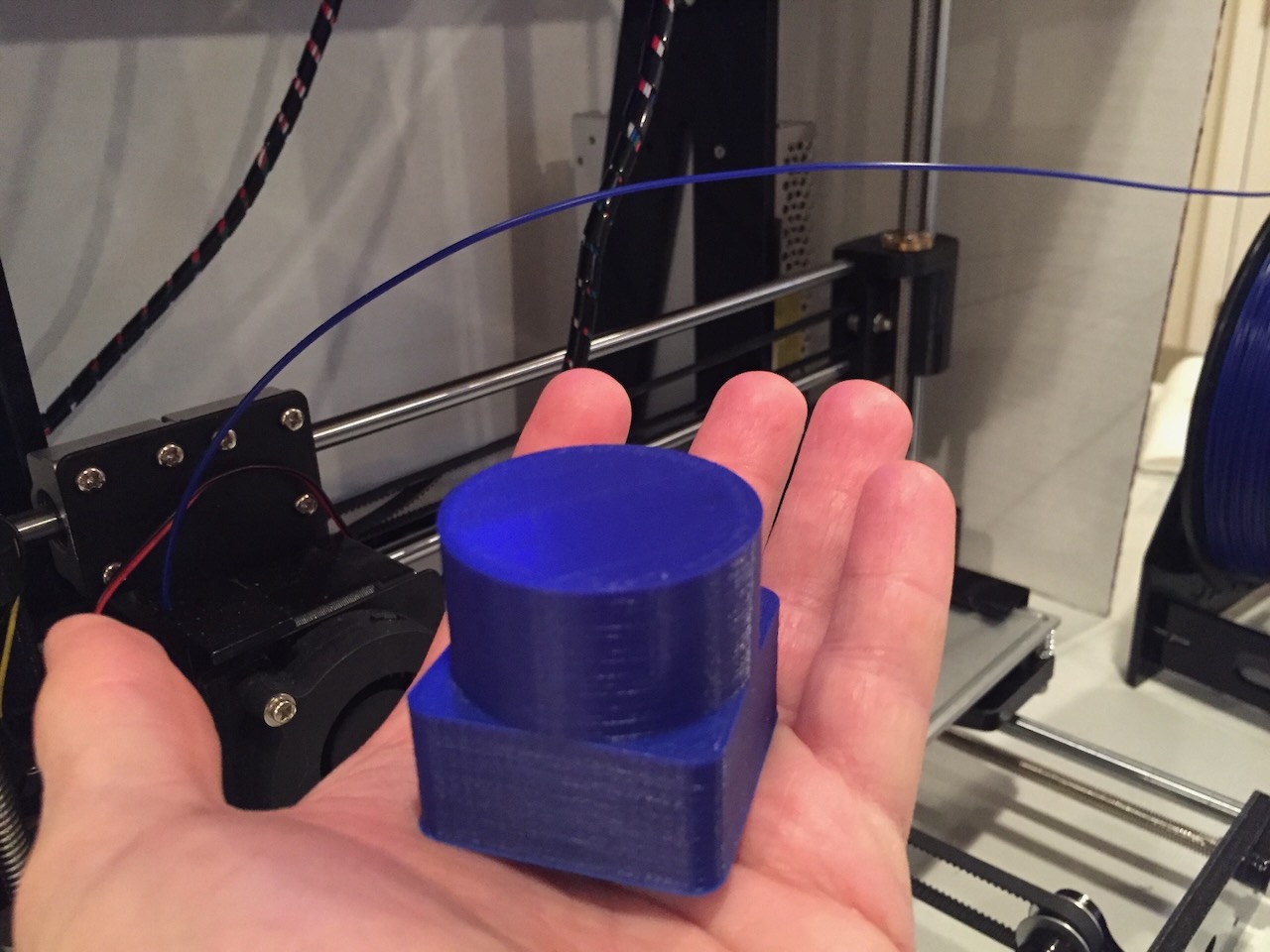
The idea of 3D printing intrigued me, but I had a habit of picking up hobbies, and not following through on them, and I didn't want to spend a lot of money on a machine that I would just put away in the closet if it didn't hold my interest. In 2016 I found a $186 3D printer kit on a Chinese tech gadget site. I figured for that kind of money, I wouldn't be too upset if it didn't work out.
The instructions were minimal and badly translated. I found some pictures online that someone posted of a fully assembled one, and managed to use that in combination with the instructions to assemble the machine. In my first attempt to use it, I ran the nozzle into the print bed. But, I found that nozzles were cheap, and readily available online, so I ordered a new one. Then I found some general bed leveling instructions, and some other helpful videos, and I got my first successful test pring (pictured above).
From there I was off to the races. I taught myself how to use Blender to make my own 3D models, and soon I was making all kinds of things. I spent a lot of time dialing in the printer, making it as good as I could. But, eventually I wanted a better machine, so I upgraded to a Prusa printer.

I did experiments with geometrical figures: a sculpture made out of many small dodecahedrons stuck together in a shape that looks like a model of a molecule, a knot, a figure of three intersecting golden rectangles (if you connect the corners, it makes an icosahedron), a donut shaped figure that is a long rectangular prism given a 90º twist and the ends connected together. I invented a little tool to help fix drawstrings that come out of your clothing. I also came up with a method of 3D printing halftone images.
These days I mainly use 3D printing for practical things, like fixing things around the house, or to help with my other projects in the shop.